
Data middle platform
The data middle platform is an open enterprise data management and service platform built by Youyun Shuzhi. Following the chain of "collection and synchronization—quality governance—metadata management—open services," it provides wizard-based synchronization tasks based on the DataX/FlinkX execution engines, supports access to more than 20 types of data sources, and offers quality validation, data lineage, API masking, and BI integration, turning scattered data into trusted and usable digital assets.
Core function
Provide stable, efficient, and secure functional capabilities around core business processes to help enterprises quickly complete product landing and continuous operation.
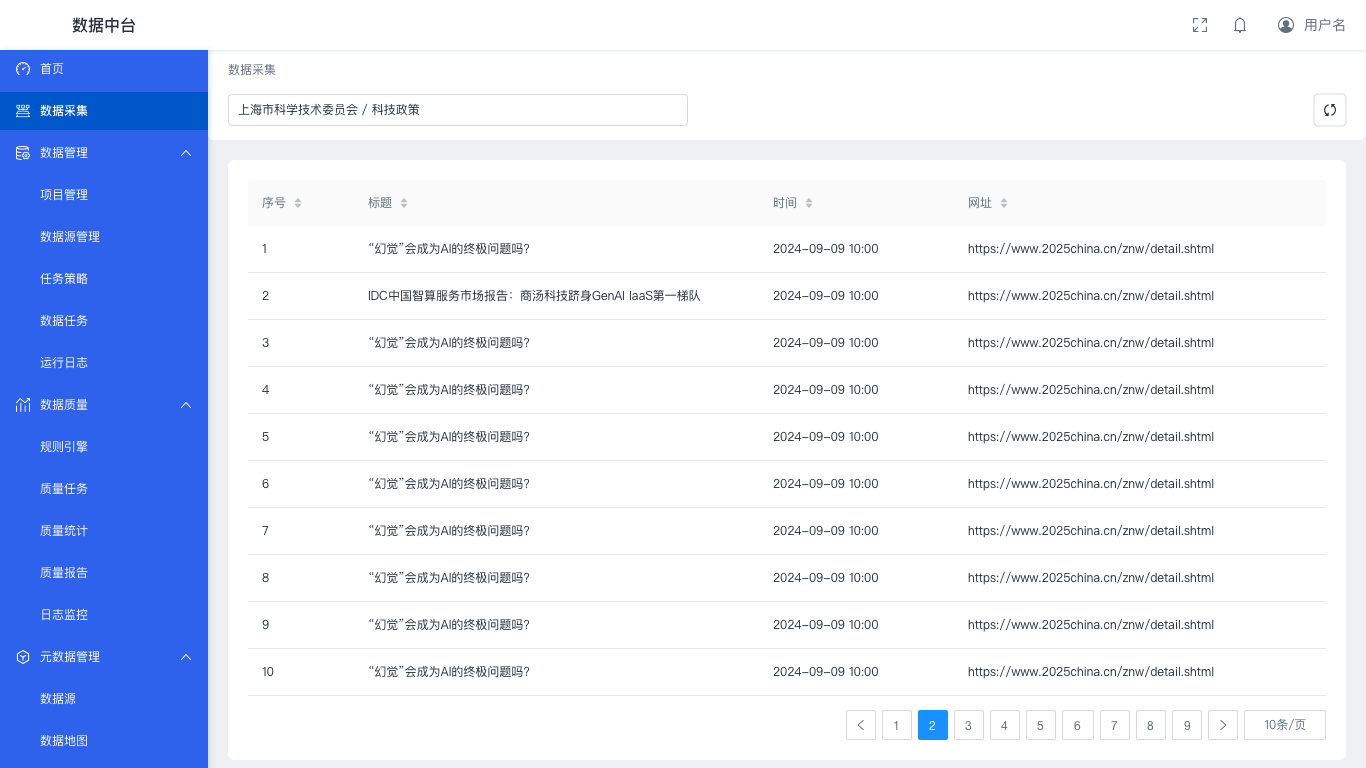
Data Acquisition and Synchronization
Single/multi-task wizard-style creation, field splitting for parallel reading, pre/post SQL support for batch processing of sharded tables, and automatic generation of DataX-executable JSON.
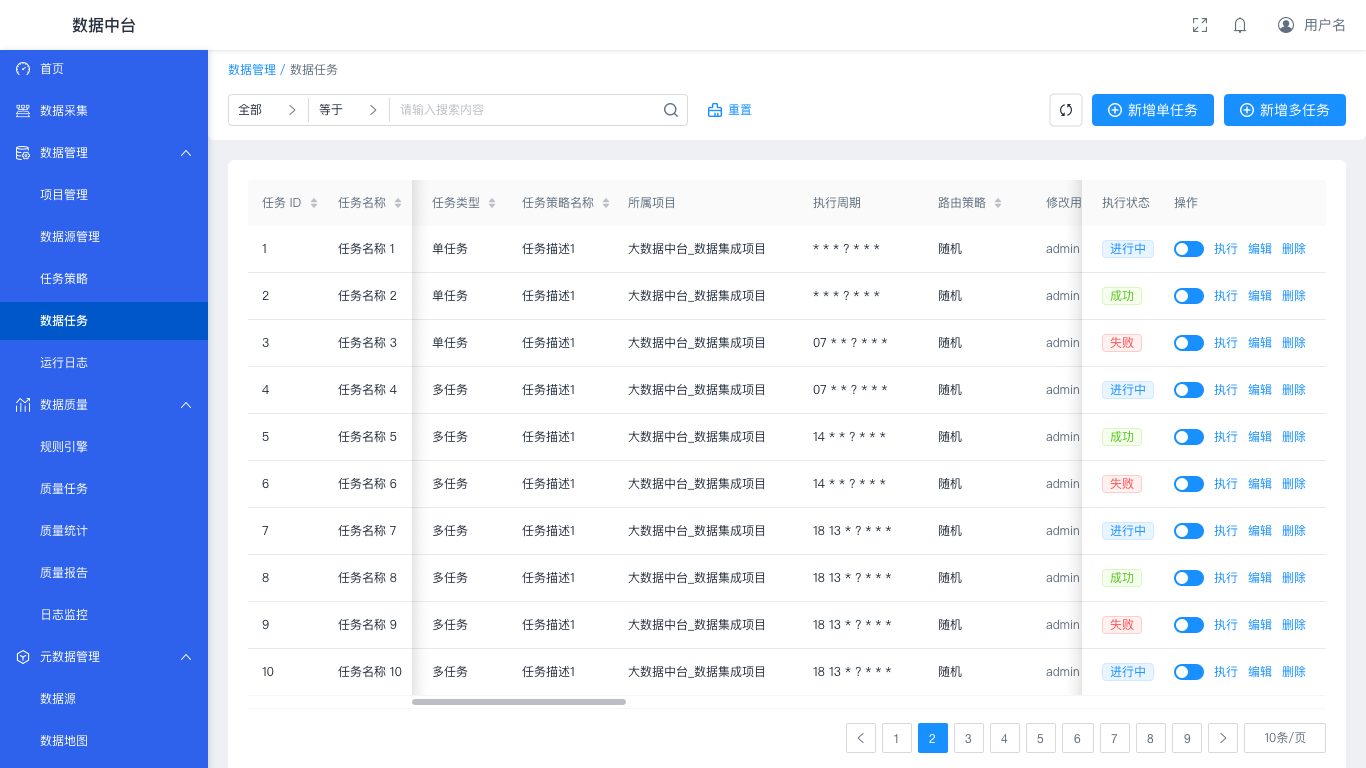
Task Scheduling Management
Executor cluster architecture, 7 routing strategies and 3 blocking handling strategies, Cron-based scheduled execution or manual triggering, and full query access to execution logs.
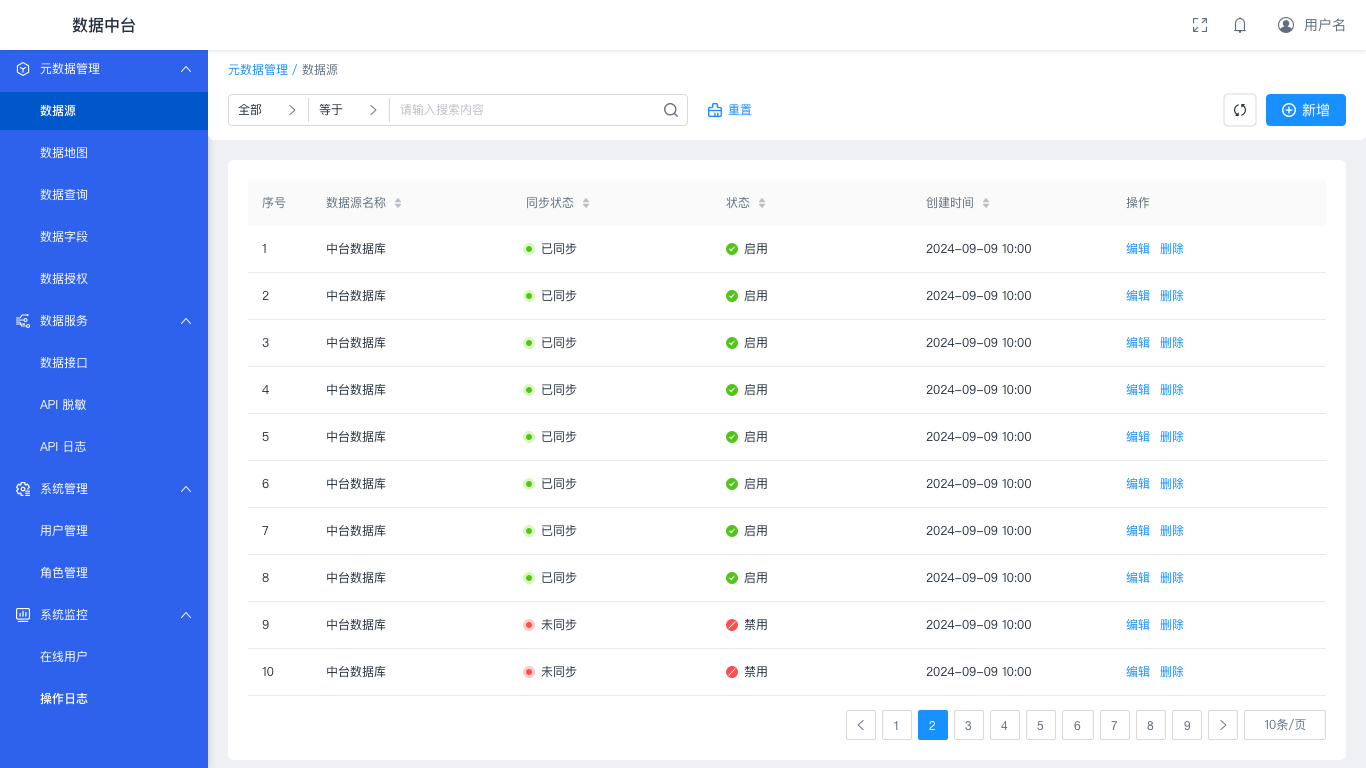
Data Quality and Metadata
Closed-loop governance for 5 types of validation rules, automatic generation of quality tasks/statistics/reports, data map, lineage, and global search, field-level authorization.
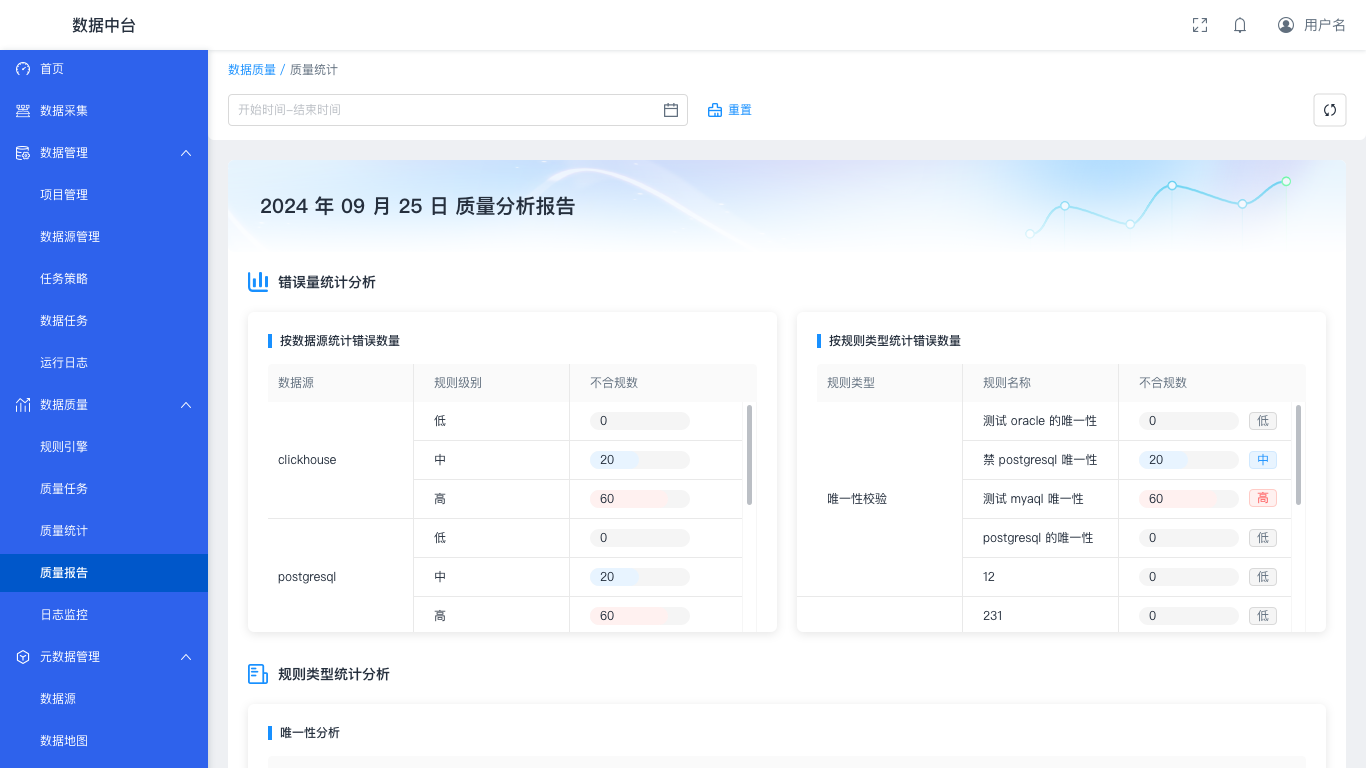
Data Services and BI
API visual creation (table-guided/script mode), field-level masking, call log tracing, Dataease dashboard integration
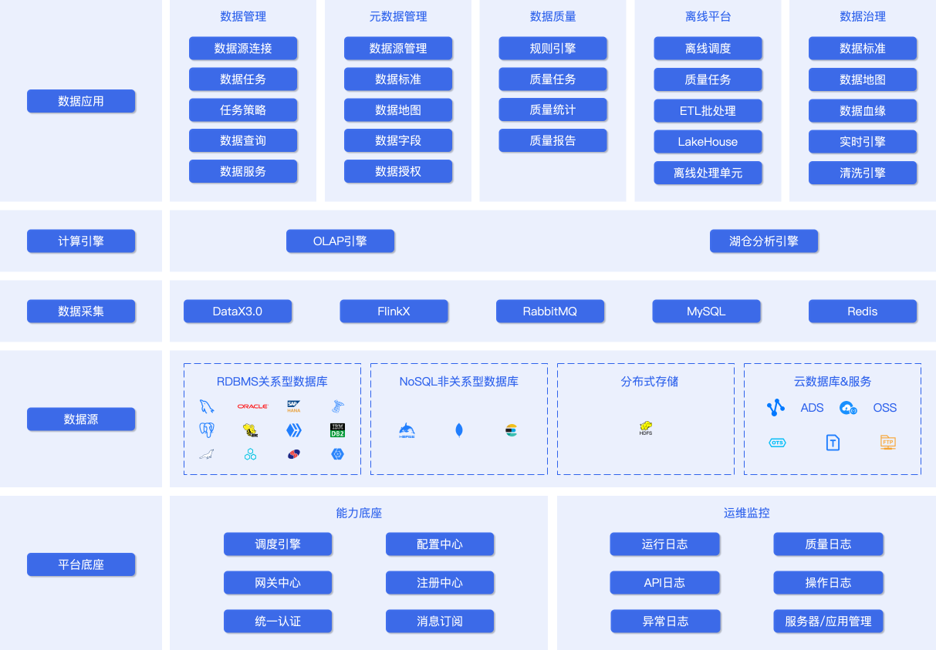
Product architecture
Carry core capabilities with modular architecture, taking into account system stability, elastic expansion, and multi-scenario integration requirements.
Product highlights
Focus on performance, security, ease of use, and scalability, continuously enhancing the comprehensive value of the product in complex business scenarios.
Coverage of over 20 types of data sources
RDBMS/NoSQL/HDFS/cloud services are plug-and-play, fully compatible with domestic databases, and offer zero-barrier access to heterogeneous data sources.
DataX+FlinkX dual executor
DataX 3.0 is built in by default, stable and efficient, and supports extending executors such as FlinkX, accommodating both offline batch and real-time scenarios.
Field-level API data masking
Sensitive fields can be masked by selecting a desensitization type with one click; API examples let you verify the results; data can go out while staying protected.
Dual-version flexible delivery
The Community Edition covers basic synchronization, while the Enterprise Edition completes the full chain of quality, metadata, and open services—choose based on your needs.
Application scenario
Suitable for various business and industry scenarios, helping organizations quickly build replicable and scalable digital application capabilities.
Enterprise Data Warehouse and Data Lake Construction
For government and enterprise customers building data warehouses and data lakes, it unifies scattered business data into the warehouse through visual tasks, supports sharded databases and incremental synchronization, provides continuous data supply for reports and BI dashboards, and reduces duplicate development costs.
Data Quality Governance Special Initiative
For enterprises with poor data quality that constrains business decisions, it continuously inspects core fields through five types of validation rules, automatically generates quality reports, quickly identifies dirty data and closes the loop on remediation, enabling business departments to confidently use and trust the data.
Data Openness and API Servitization
For enterprises that provide external data services or internal sharing, quickly publish governed data as APIs, support table-guided and script modes for interface creation, ensure security through field-level masking, make call logs fully traceable, and realize service-oriented operation of data assets.
Group Multi-System Data Aggregation and Supervision
For large groups with numerous subsidiaries and branches and a proliferation of systems, it provides unified management of heterogeneous databases, uses data maps and data lineage to clarify the data landscape, assigns differentiated permissions by role, and enables global data viewing, authorization, and monitoring in a single system, making group data controllable and available.